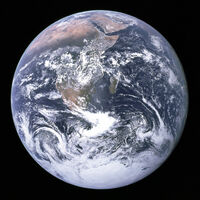
Earth

Viewed from space, Earth appears as a bright blue planet because the world’s oceans cover more than two-thirds of its surface. The fact that life has been able to emerge and evolve in such incredible diversity on our planet is due to the abundant supply of water. In fact, we should call Earth the “water planet.”


Without liquid water, organic life as we know it cannot arise. It depends on the biochemical processes involving countless carbon compounds, which can only occur within the narrow temperature range in which water is liquid.


However, for an environment conducive to life, it has always been—and remains—essential for a planet to have a protective atmosphere and to orbit a star at a “suitable” distance, a star that radiates evenly over billions of years.

Not too long ago, it was widely believed that the origin of life was an extremely unlikely event that might never have occurred a second time in the universe. Today, however, we know that countless stars in the Milky Way alone are surrounded by planetary systems, and new “exoplanets” are constantly being discovered.

Nevertheless, although we may speculate that life has arisen or is still arising beyond our planet, Earth—the “Blue Planet,” consisting of about two-thirds water—is the only known celestial body on which life exists.

Earth has only one moon. It orbits Earth at an average distance of 384,400 kilometers (85 mm in the model). The Moon is the most thoroughly explored celestial body other than Earth—and so far the only one that humans have set foot on."

Data Overview

Surface

Rocky planet in the inner solar system

Number of moons

1 Moon: Diameter 3,474 km
(Model: 0.8 mm)

Mass

1 Earth mass = 5.972 × 10²⁴ kg

Diameter

3,474 km (model: 0.8 mm)

Distance from the Sun
  • At perihelion: 147.05 million km
    (model: 32.7 m)
  • At aphelion: 152.14 million km
    (model: 33.8 m)
Turnaround time

365 days, 6 hours, 8 minutes, 38 seconds = 1 year

Distance traveled in 24 hours
  • At perihelion: 2.617 million km
    (Model: 58 cm)
  • At aphelion: 2.531 million km
    (Model: 56 cm)
Rotation Duration

23 hours, 56 minutes, and 4 seconds

Inclination of the equatorial plane relative to the orbital plane

23.45 degrees

Direction of rotation

clockwise (like a train loop)

Average Energy Irradiance

1,367 watts/m²

Mean Solar Angular Diameter

0.534 degrees

Temperature
  • Minimum temperature: -93 °C
  • Average temperature: 15 °C
  • Maximum temperature: 58 °C
Atmosphere
  • 78.1% nitrogen (N₂)
  • 21.0% oxygen (O₂)
  • 0.9% argon (Ar)
Weather

The tilt of the Earth's axis relative to the vertical axis of the ecliptic gives rise to the seasons that shape our climate.