Jupiter

After the Sun, this planet is by far the largest and heaviest body in the entire solar system. Its diameter is twelve times that of Earth’s, and its mass is two and a half times that of all the other planets combined.


In ancient times, the giant Jupiter was considered the “father” of the planetary gods: Jupiter to the Romans, Zeus to the Greeks. Despite its enormous size, it rotates faster than all the other planets, completing one rotation in just under 10 hours.


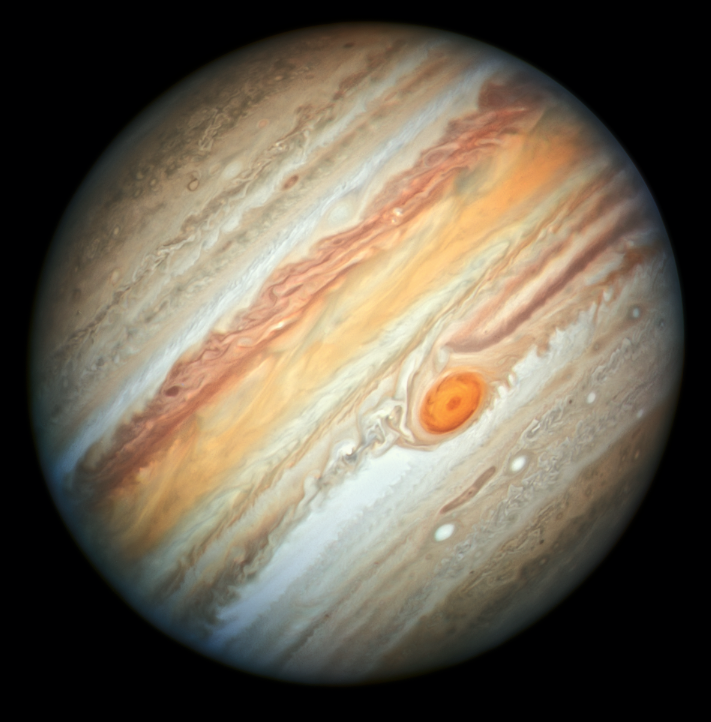
Unlike the inner planets, Jupiter is not a rocky planet but a gas giant. It has no solid surface and—like the Sun—consists primarily of the elements hydrogen and helium. The dark and light bands running parallel to the equator are cloud bands in the dense atmosphere, which contain molecules such as methane, ammonia, and sulfur compounds, among others.

Almost four hundred years ago, the enormous “Red Spot” was observed near the equator. It is nothing more than a cyclone—which has been raging for (at least) centuries—about twice the size of Earth. Wind speeds reach up to 700 kilometers per hour. However, new cyclones are constantly forming in the turbulent atmosphere.

As of today (2026), about 100 of Jupiter’s moons are known. The largest of them (Io, Europa, Ganymede, and Callisto) were discovered in the early 17th century by the astronomer Galileo Galilei. Their orbit around the planet, which takes only a few days, can be easily observed from Earth with binoculars.

Data Overview

Surface

Gas Planet

Number of moons

about 100 (2026)

Mass

318 Earth masses

Diameter

142,984 km (Model: 31.8 mm)

Distance from the Sun
  • At perihelion: 740.51 million km
    (model: 164.6 m)
  • At aphelion: 816.66 million km
    (model: 181.5 m)
Turnaround time

11 years, 315 days

Distance traveled in 24 hours
  • At perihelion: 1.185 million km
    (model: 26 cm)
  • At aphelion: 1.075 million km
    (Model: 24 cm)
Rotation Duration

9 hours, 55 minutes, 30 seconds

Rotation Axis Tilt

3.13 degrees

Direction of rotation

clockwise (like a train loop)

Average Energy Irradiance

50 watts/m²

Mean Solar Angular Diameter

0.10 degrees

Temperature

-108 °C

Atmosphere
  • 89.8% hydrogen (H₂)
  • 10.2% helium (He)
  • 0.3% methane (CH₄)
  • Clouds of ammonia (NH₃)
Weather

Constant severe storms and electrical discharges in the gas envelope

First Probe Mission

1973 Pioneer 10 Space Probe (U.S.)