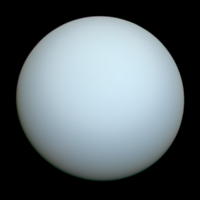
Uranus

Since prehistoric times, people have observed, in addition to the Sun and the Moon, five “wandering stars” in the sky that moved ceaselessly through the constellations, which appeared unchanging. In ancient times, these “planets” were equated with gods: Mercury, Venus, Mars, Jupiter, and Saturn.


On March 13, 1781, William Herschel discovered, using a reflecting telescope he had built himself, a greenish, diffuse object that could not be a fixed star. At first, he thought it was a comet, but he soon realized that it must be a planet. To fit it into the series of planets named after gods, the new wandering star was named “Uranus.”

Under favorable observing conditions, Uranus can be seen even with a small telescope as a blue-green disk with no discernible structure. The gas giant has a diameter of 51,000 kilometers and rotates around its axis in 17 hours and 14 minutes; unlike all other planets, its axis of rotation lies in the plane of its orbit.


Furthermore, the direction of its rotation is opposite to the direction of its orbital motion. As with all other gas giants, Uranus rotates faster at the equator than at the poles. It takes Uranus 84 Earth years to orbit the Sun—almost three times as long as Saturn, which is much closer to the Sun.

In its methane-rich hydrogen-helium atmosphere, where temperatures reach minus 197°C, violent storms rage at speeds of up to 700 kilometers per hour. As of today (2026), we know of 29 moons of Uranus. The four largest of these have diameters ranging from 1,578 kilometers (Titania) to 1,158 kilometers (Ariel).

Data Overview

Surface

Gas Planet

Number of moons

29 (2026)

Mass

14.5 Earth masses

Diameter

51,118 km (scale: 11.4 mm)

Distance from the Sun
  • At perihelion: 2,741 million km
    (model: 609 m)
  • At aphelion: 3,003 million km
    (model: 667 m)
Turnaround time

84 years and 4 days

Distance traveled in 24 hours
  • At perihelion: 617,000 km
    (Model: 14 cm)
  • At aphelion: 561,400 km
    (Model: 12 cm)
Rotation Duration

17 hours, 14 minutes, 52 seconds

Rotation Axis Tilt

97.77 degrees

Direction of rotation

reverse (opposite to the track's direction of travel)

Average Energy Irradiance

3.7 watts/m²

Mean Solar Angular Diameter

0.03 degrees

Temperature

-197 °C

Atmosphere
  • 82.5% hydrogen (H₂)
  • 15.2% helium (He)
  • 2.3% methane (CH₄)
Weather

Due to the steep axial tilt, the seasons last an extremely long time (21 years)

First Probe Mission

1986 Voyager 2 Space Probe (U.S.)