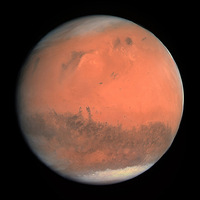
Mars is the most Earth-like planet in the solar system. A Martian day is about 0.5 hours longer than an Earth day, and a Martian year lasts just under two Earth years. The planet has a very thin atmosphere composed of carbon dioxide, and temperatures range from minus 85°C at night to as high as plus 20°C during the day. The Martian landscapes are also extreme: there are taller mountains (up to 26 km) and deeper canyons than on Earth. It is believed that liquid water existed on Mars long ago, perhaps even oceans. Today, there is virtually no water left on Mars, except for trace amounts in the polar caps, along with frozen carbon dioxide (dry ice). The two irregularly shaped moons, “Phobos” and “Deimos,” each only a few kilometers in size, may be small bodies captured from the “asteroid belt” between Mars and Jupiter by the planet’s gravity.
