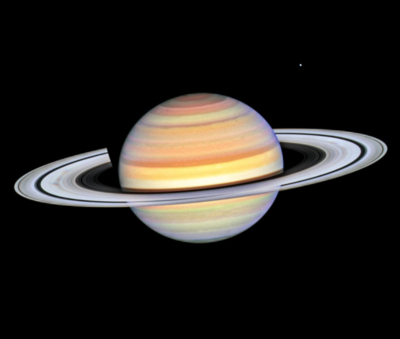
At 10 hours and 40 minutes, Saturn takes only 45 minutes longer than Jupiter to complete one rotation on its axis. Its orbital period around the Sun, at 29.5 years, is about two and a half times as long as Jupiter’s (11.9 years).
Like all gas giants, Saturn has no solid surface. The outer layers of its atmosphere consist of hydrogen (93%) and helium (7%), with small amounts of methane and ammonia. At temperatures ranging from minus 140°C to minus 190°C, storms rage through the atmosphere at speeds of up to 1,600 kilometers per hour. As on Jupiter, a stationary, permanent hurricane with a diameter of 8,000 kilometers can be observed on Saturn.
To date (2026), 285 of Saturn’s moons are known. The largest (Titan), at 5,150 km, is about 1.5 times the size of Earth’s moon.
