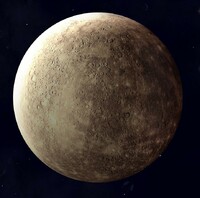
Mercury

Mercury, which has no moons, is the smallest planet in the solar system and, like Venus, Earth, and Mars, is a terrestrial planet. With a diameter of 4,880 km, it is larger than Earth’s Moon but smaller than the largest moons of Jupiter and Saturn.


Orbiting the Sun in a highly elliptical path, Mercury completes one revolution in 88 days and, with an average distance from the Sun of 58 million km, is the planet closest to the Sun and the fastest-moving. Because of its high orbital speed, the Romans associated Mercury with the messenger of the gods (Greek: Hermes) and often depicted him with winged feet.

With its heavily cratered surface, Mercury closely resembles the Moon. It rotates three times on its axis during two orbits around the Sun. Because of its low gravity, it cannot retain an atmosphere that could help balance temperatures between the day and night sides. As a result, surface temperatures range from 430 °C on the day side to minus 170 °C on the night side.

Data Overview

Surface

A rocky planet with many craters

Number of moons

0

Mass

0.055 Earth masses

Diameter

4,879 km (scale: 1.1 mm)

Distance from the Sun
  • At perihelion: 46.0 million km
    (model: 10.2 m)
  • At aphelion: 69.8 million km
    (model: 15.5 m)
Track Cycle Time

87 days, 23 hours, 15 minutes

Distance traveled in 24 hours
  • At perihelion: 5.096 million km
    (Model: 113 cm)
  • At aphelion: 3.357 million km
    (Model: 75 cm)
Rotation Duration

58 days, 15 hours, 36 minutes

Rotation Axis Tilt

0.034 degrees

Direction of rotation

clockwise (like a train loop)

Average Energy Irradiation

9,123 watts/m²

Mean Solar Angular Diameter

1.38 degrees

Temperature
  • Minimum temperature: -173 °C
  • Average temperature: 167 °C
  • Maximum temperature: 427 °C
Atmosphere

virtually nonexistent, since it is too low in mass

Weather

not real weather

First Probe Mission

1983 Mariner 10 (U.S.)