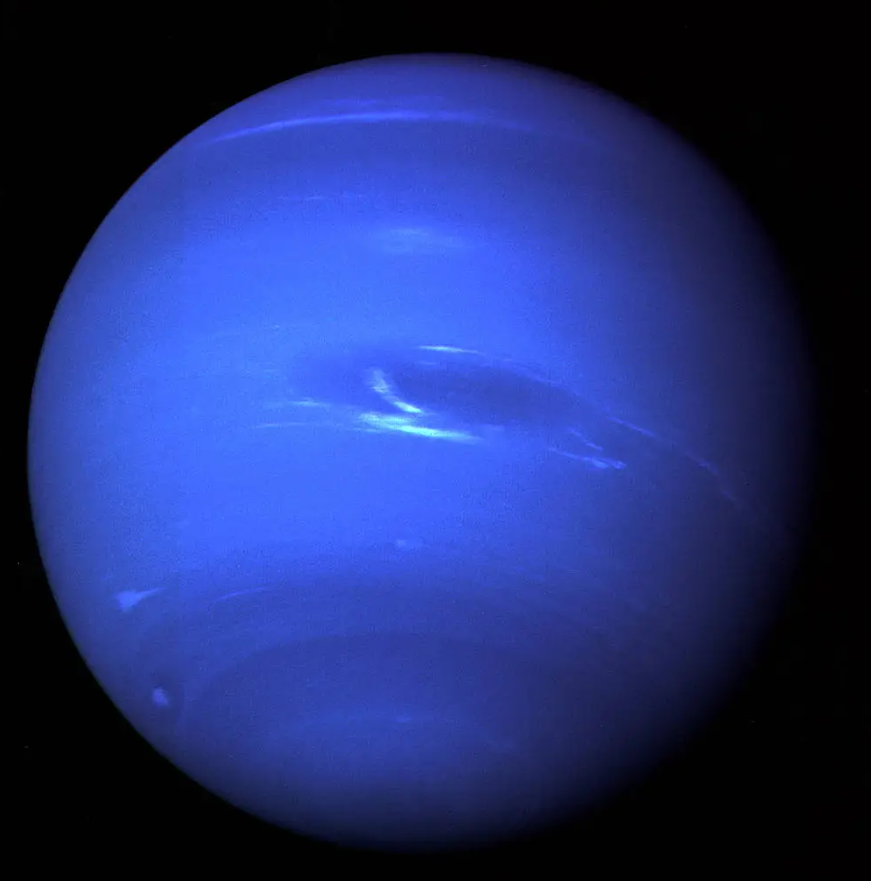
Neptune

Neptune, the fourth-largest planet in the solar system and the one farthest from the Sun, is, like Uranus, invisible to the naked eye from Earth.


It was discovered by the German astronomer Johann Gottfried Galle at the Berlin Observatory after he received a tip from his colleague Urbain Le Verrier, then director of the Paris Observatory. Le Verrier had studied the orbital perturbations of Uranus caused by the gravitational pull of an unknown body and had calculated in advance where in the sky the perturbing mass should be found.


Just one degree away from the predicted position, Galle discovered a faint object in 1848 that was not marked on any star chart, and was able to prove, based on its minute proper motion, that the object was a planet. Astronomers named the eighth planet after the Roman god of the sea, Neptune (Greek: Poseidon), so that, like Uranus, it would fit into the series of ancient planetary gods.

The planet is about 30 times as far from the Sun as Earth is and takes nearly 165 years to complete one full orbit. Like the gas giants, Neptune has no solid surface. Its hydrogen-helium atmosphere, with a temperature of minus 220° C, exhibits a banded structure due to the planet’s rapid rotation—just under 16 hours per revolution—and appears bright blue because of its high methane content. The strikingly white clouds of methane snow rapidly change their appearance.

Storms rage through the atmosphere at speeds of up to 2,000 kilometers per hour. These are the highest wind speeds ever measured in the solar system.

Data Overview

Surface

Gas Planet

Number of moons

16 (2026). Triton (diameter 2,707 km) is the largest

Mass

17.1 Earth masses

Diameter

49,528 km (scale: 11 mm)

Distance from the Sun
  • At perihelion: 4,444 million km
    (model: 988 m)
  • At aphelion: 4,546 million km
    (model: 1,010 m)
Turnaround time

164 years, 289 days

Distance traveled in 24 hours
  • At perihelion: 472,600 km
    (Model: 11 cm)
  • At aphelion: 466,600 km
    (Model: 10 cm)
Rotation Duration

15 hours, 57 minutes, 59 seconds

Rotation Axis Tilt

28.32 degrees

Direction of rotation

clockwise (like a train loop)

Average Energy Irradiance

1.5 watts/m²

Mean Solar Angular Diameter

0.02 degrees

Temperature

-201°C

Atmosphere
  • 80% hydrogen (H₂)
  • 19% helium (He)
  • 1.5% methane (CH₄)
Weather

extremely cold and windy

First Probe Mission

1989 Voyager 2 Space Probe (U.S.)