The Sun is the center of the solar system, which consists of eight planets, numerous moons, and many millions of smaller celestial bodies. With a mass of 333,000 Earth masses, it is a thousand times more massive than all the other bodies in the solar system combined.
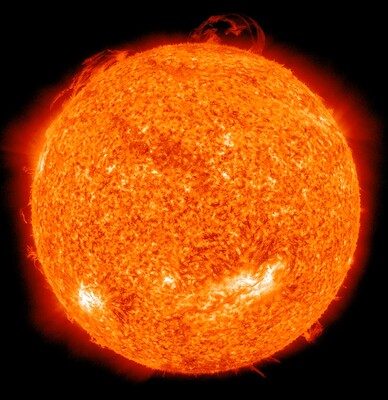
It is a star in the Milky Way: a hot ball of gas with a diameter of about 1.4 million kilometers. In reality, this distance is 109 times the diameter of Earth, but in our model it is only 31 centimeters.
Inside the Sun, under extreme pressures and temperatures (15 million degrees), 400 million metric tons of hydrogen nuclei fuse into helium nuclei every second (nuclear fusion). This process releases a vast amount of energy, causing the Sun to shine with a surface temperature of 5,500 °C.
With a diameter of just under 1.4 million kilometers, the Sun contains nearly the entire mass of the solar system (99.9%). Its immense gravitational pull keeps all other bodies in elliptical orbits (Kepler’s laws). Depending on the shape of these ellipses, the orbiting bodies (e.g., planets) do not—as would be the case with ideal circular orbits—always remain at the same distance from the Sun, but instead approach the Sun at “perihelion” during each orbit and then move away again to “aphelion”. Their orbital velocity also changes in the process; it is greater at “perihelion” than at “aphelion.”