Welcome to Planetenallee

With this model of the solar system, the “Freundeskreis Mannheimer Planetarium e.V.” aims to convey interesting information about the solar system and illustrate its astonishing dimensions.

While everyone knows that our Earth, along with the other planets, orbits the Sun, hardly anyone can even begin to imagine the true dimensions of the solar system. Neither books nor films nor interactive media can bring this to life.

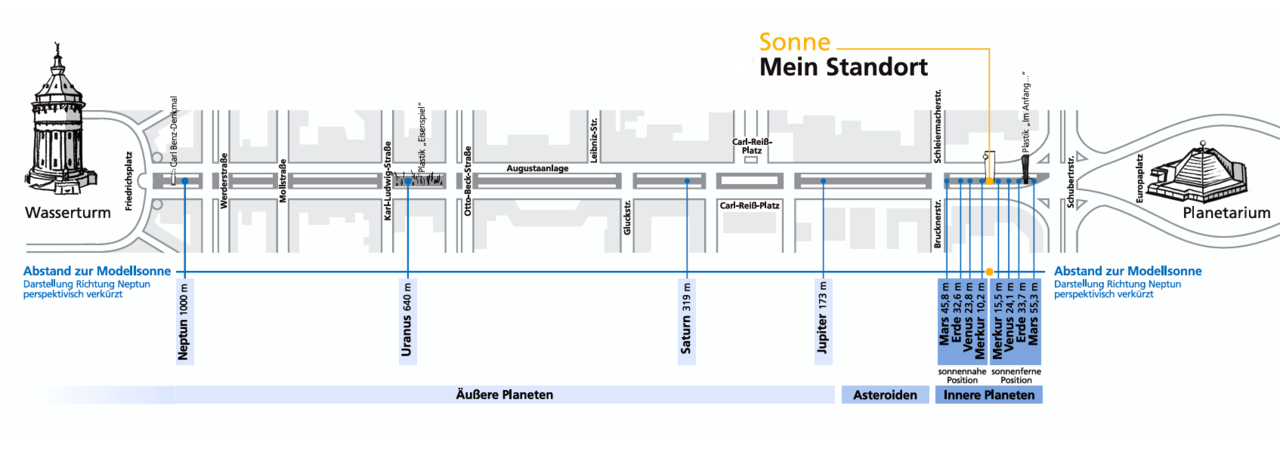
The true-to-scale model of the solar system, located along the Augustaanlage between the planetarium and the water tower, depicts the size of the Sun, the planets, and the distances between the celestial bodies all on the same scale of 1:4.5 billion. One centimeter in the model corresponds to 45,000 kilometers in reality.

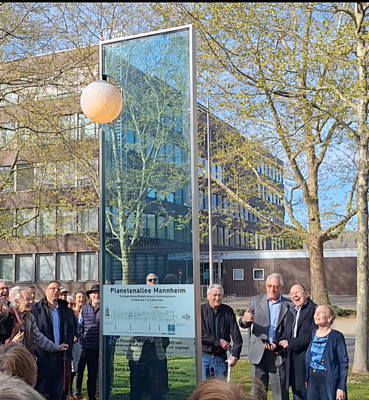
The installation consists of a model sun—a glowing sphere with a diameter of just under 31 cm—integrated into a 360 cm-high glass stele, as well as 12 glass panels embedded in the ground that mark the location of each planet. Since the panels have exactly the same diameter as the “model sun,” the planets’ minuscule size compared to the sun is immediately apparent. This allows visitors to experience just how infinitesimally small the planets are compared to the gigantic scale of the solar system.
Planetary Disks

Planetary Disks

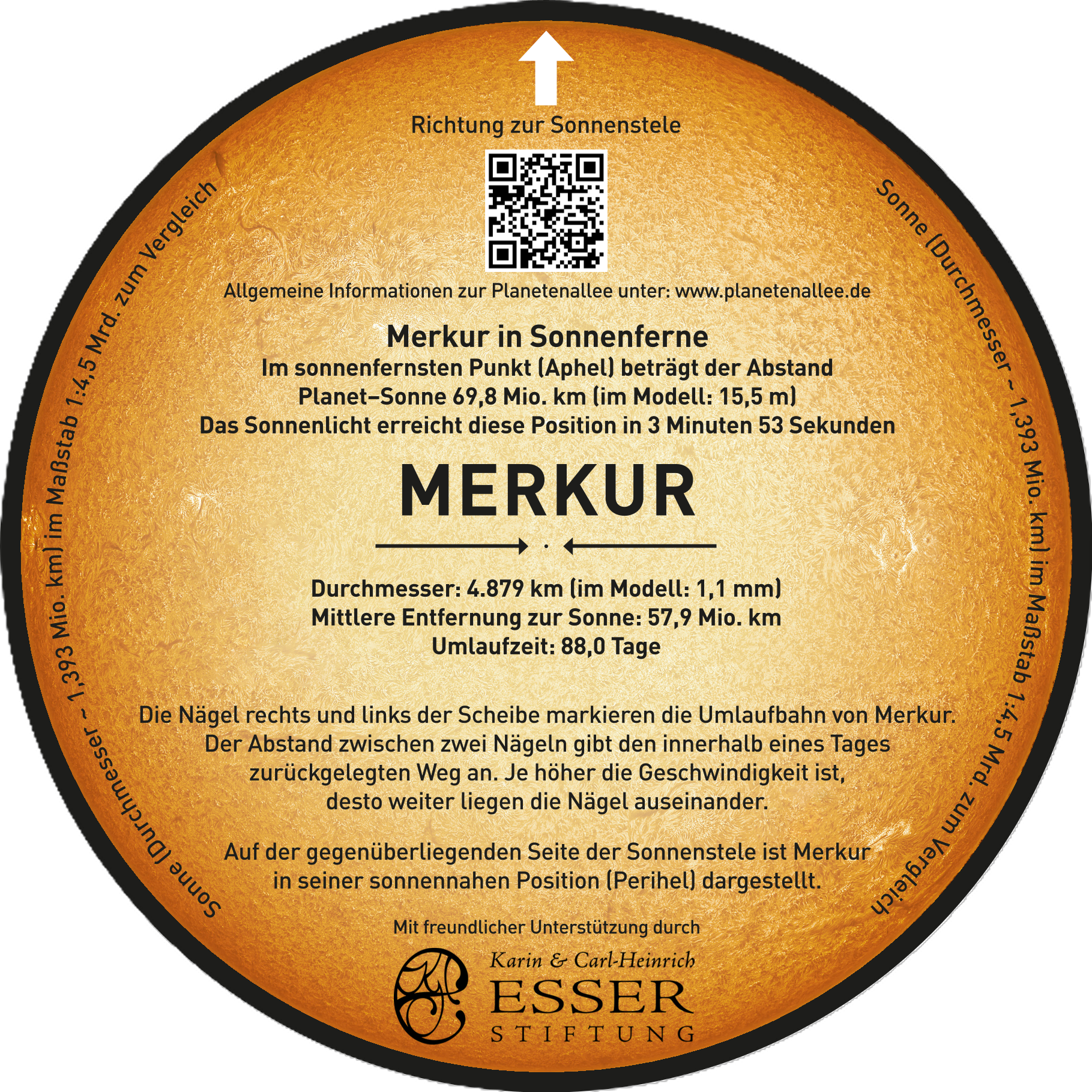
The planets are depicted on glass discs at a scale-accurate distance from the Sun as small black dots of corresponding diameter. The discs are embedded in the floor, illuminated from below, and have a diameter that exactly matches that of the model Sun. This allows for a direct comparison of the sizes of the planets and the Sun. From each planet’s position, the luminous solar sphere can be seen at the angular diameter at which it appears in the sky above that planet.

To distinguish them from the surrounding water-bound surface, the glass panels are embedded in a 3 x 1-meter concrete paving frame. The spacing between the nails embedded in the frame indicates the distance each planet travels within 24 hours.

The inner planets—Mercury, Venus, Earth, and Mars—are shown both at their closest point to the Sun, the “perihel” (pronounced “peri-hel”), and at their farthest point from the Sun, the “aphel” (pronounced “ap-hel”). This illustrates that the planetary orbits are elliptical—in some cases, even highly so. The outer planets—Jupiter, Saturn, Uranus, and Neptune—are shown only once due to space constraints. All the planet discs feature QR codes that can be scanned with a smartphone to access information. This way, you can learn a lot about the solar system while taking a stroll along the Planetary Walk. And if you want to see and hear even more about the planets, stars, and galaxies, visit the planetarium located right nearby. Have fun!